
Lunar Infrastructure
Building new infrastructure on the Moon
Alterna Robotics is building infrastructure to support lunar activity through robotics and digital technology. Our first mission is pre-mission evaluation using a lunar digital twin and test rovers.
Our first mission
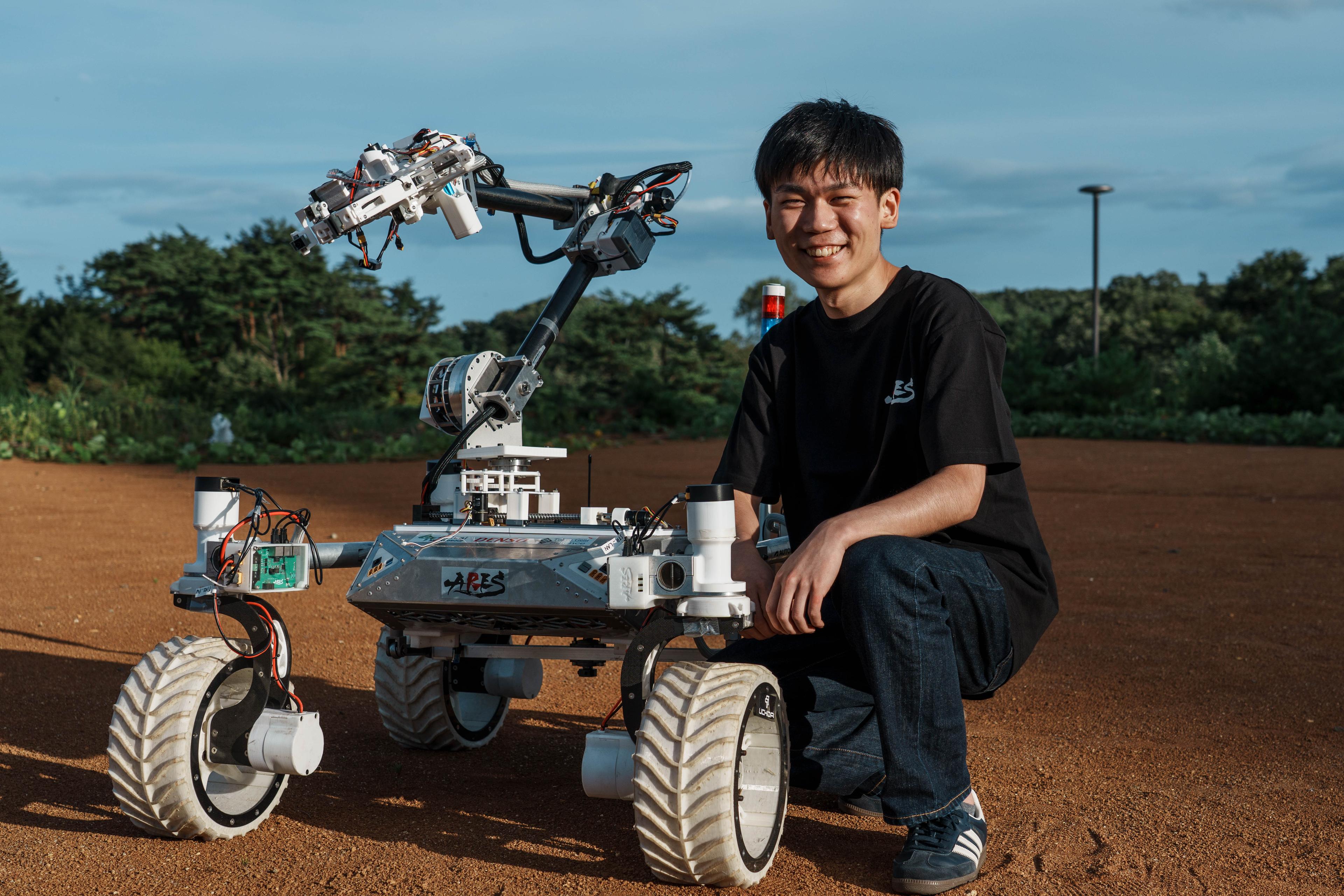
Our first mission toward building lunar infrastructure is pre-mission evaluation using a lunar digital twin. Building on our CEO's doctoral research results, we are calibrating the Particle Dynamics Engine through in-house hardware tests and continuing its research and development. Our rendering engine addresses lunar lighting and the reflection and spectral characteristics captured by physical cameras, connecting simulation with reality through Sim2Real.
Our business
Three planned offerings will bring our first mission into commercial use: mission evaluation, rover provision, and digital twin and data licensing. We will develop them in stages, building on our ability to create both simulators and real hardware.
01
Pre-mission evaluation
A project-based evaluation fee.
We are developing a service to evaluate customer vehicles and task plans in a lunar digital twin. Using our in-house particle dynamics and rendering research, we aim to examine terrain, driving and task conditions alongside light, shadows and visual perception, then use hardware comparisons to identify planning risks.
02
Rover provision
Instrument integration and experiment fees, plus mission participation fees.
We aim to design, build and provide rovers for ground experiments and space missions, fitting task-specific instruments to a common chassis. Owning both the hardware and the simulator lets experimental results feed back into model improvements.
03
Digital twin and data licensing
Annual license and data usage fees.
We plan ongoing access to a digital twin and data calibrated against measurements. Our research into particle and lighting simulation aims to support a Sim2Real environment for training perception and control and evaluating transfer to hardware, connecting mission evaluation with autonomous-operation development.
From particles and light to Sim2Real
Our core technologies are a Particle Dynamics Engine based on our CEO's doctoral research results and an in-house rendering engine for lunar lighting. With both hardware and software expertise, we combine physical validation, calibration and further research to address motion and visual appearance through Sim2Real.
Particle Dynamics Engine
Building on our CEO's doctoral research results, we model particle contact, friction, motion and vehicle interaction. Comparisons with our own rovers guide calibration and continuing research and development.
Rendering Engine
We are developing an in-house rendering model for lunar light and shadows, including surface reflection and spectral characteristics as captured by physical cameras. Comparison with real images supports perception and localization evaluation.
Sim2Real
Our Particle Dynamics Engine supports reinforcement learning (RL) with thousands of virtual rovers and model-based behavior validation. We vary terrain, vehicle and control conditions for training and validation, then connect the results with Sim2Real through comparison and calibration using our own hardware.
Discuss mission evaluation and joint development
We welcome construction companies planning lunar operations, space companies developing rovers, landers and payloads, and space agencies and research institutions. We are also exploring applications in terrestrial autonomous construction and disaster response.